Showing posts with label gene david kirk. Show all posts

Friday, 10 June 2022

Stage: Grappling with identity

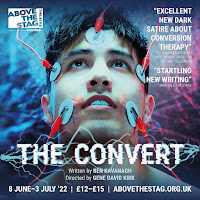
The Convert
by Ben Kavanagh
dir Gene David Kirk
with Nick Mower, Ben Kavanagh, Sam Goodchild
sets & costumes David Shields
lighting Joseph Ed Thomas
Above the Stag, Vauxhall • 8.Jun-3.Jul.22

This absolute stunner of a play grabs hold and refuses to let up, as playwright Ben Kavanagh grapples with present-day issues and attitudes in a vaguely futuristic setting. The central topic here is gay conversion therapy, although the plot deftly avoids the obvious. Surreal touches take the audience under the surface to reveal deeper thoughts and feelings, embracing contradictions and ambiguities that add a provocative kick.

The story is set after an overthrow of current Western culture, taken over by fundamentalists who have outlawed homosexuality. Arrested for being gay, Alix (Nick Mower) finds himself in a shadowy rehab centre. Unable to tell day from
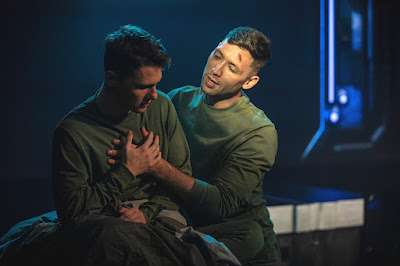
night, he's confused about the passage of time, while the Arbiter (Kavanagh) insists that Alix only give pre-approved answers to any questions before applying violent "corrections". Alix's cellmate is Marcus (Sam Goodchild), who has accepted this situation and hopes to be returned to society as a straight man who will get married and have children. The only alternative is to be sent to some mythical other place, where gay men are hidden from society.
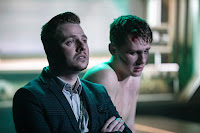
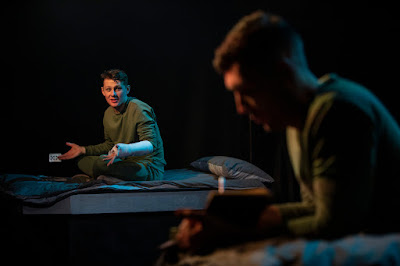
Skilfully using light, sound and video screens, the set is vividly evocative from the start, with its industrial screens, piercing illumination and rolling smoke. It looks like a cross between a spaceship and a bomb shelter, which adds to Alix's general disorientation. Beds are like alien examination tables, while the interrogation desk holds its own secrets. Meanwhile, the performances lift this show far above expectations, anchored by a raw, yearning turn from Mower in his professional debut. 

Mower makes Alix instantly sympathetic, never giving into the cruelty that's dealt to him. In blackout moments, makeup is applied to reveal the brutal injuries inflicted during this experience, and Mower conveys Alix's quiet resilience even when this gets very nasty indeed. His banter with Kavanagh's coldly acerbic Arbiter is strikingly well-played, as are the much more tender and open moments between Alix and Goodchild's intriguingly nuanced Marcus.

While the key target is gay conversion, there are much deeper things at work as this play explores how the three characters identify themselves. These thoughtful ideas are subtly played by the cast to add emotional impact. So in the final act, as the story takes a series of rather mind-spinning turns, it's this internalised journey that holds us tightly, accompanied by the haunting words of Barbra Streisand's Happy Days Are Here Again


For information, visit ABOVE THE STAG >

photos by PBGstudios • 9.Jun.22


Friday, 8 April 2016

Shadows on the Stage: A cry for freedom


HARAM IRAN
dir Gene David Kirk; scr Jay Paul Deratany
Above the Stag Theatre, Vauxhall - 5.April-1.May.16

Inspired by the true story of Mahmoud Asgari and Ayaz Marhoni, who were beaten and publicly executed in Iran in 2005 after being accused of homosexual coercion. The details of the story have never been released, but playwright and human rights lawyer Jay Paul Deratany gathered as much information as possible before weaving the story into a wrenching exploration of youthful hope in a place where freedom of thought is prohibited.

The play centres on Ayaz (Viraj Juneja), a smart 15-year-old whose professor mother (Silvana Maimone) has raised him with an appreciation of banned foreign novels like Catcher in the Rye and Les Miserables. His 14-year-old school friends Mahmoud and Fareed (Andrei Costin and Merch Husey) are more interested in playing football than reading a book. And Fareed is appalled to learn that Ayaz is carrying around "haram" (forbidden) novels. Mahmoud is more curious, and soon they are secretly meeting so Ayaz can recount these taboo stories to him. They also discover that they share a mutual attraction, which of course is also haram. And in a flash of jealousy, Fareed reports them to the authorities. Ayaz is locked up by a brutal jailor (Fanos Xenofos) and both are brought before a mullah judge (George Savvides).

Since it's based on a true story, where this goes is somewhat predictable, but Deratany fills scenes with artful observations, from literary references to quotes about love and humanity from the Quran. What emerges is a sensitive exploration of a society under the grip of Sharia law - although there's a clear sense that this is an oppressive political system using religion as an excuse to dominate and harshly control the population. Especially the female population.

As with most Above the Stag productions, this one is ambitiously staged by director Gene David Kirk and sharply performed in an intimate space. Designer David Shields creates the atmosphere of a prison, with brutal concrete areas that force the characters to toe the line. This immediately establishes a grave tone, lightened in the early scenes with witty asides. After the interval, there's no more levity, and the emotional kicks get increasingly forceful. This is a seriously haunting play that not only highlights the injustice of any tyrannical regime but also tenderly portrays the honest humanity of young people who are just beginning understand that their rulers are oppressors. For these boys it's natural to dream of a bigger world, to yearn for freedom and to find a soulmate in an unexpected place.

Saturday, 12 September 2015

Shadows on the Stage: Like father like son

The Sum of Us
scr David Stevens • dir Gene David Kirk
Above the Stag Theatre, Vauxhall • 9.Sep-4.Oct.15

The plucky Above the Stag Theatre deploys its now-expected professionalism in this revival of David Stevens' award-winning 1990 play, which was adapted into the 1994 film starring the great Jack Thompson and a young Russell Crowe. Not only are all four of the cast members well up to the challenge, but the set designers have outdone themselves to create a detailed Melbourne home in a very tiny space, plus a terrific last-act transformation.

Set in the late 1980s, the story centres on Harry (Stephen Connery-Brown, above left), a widower who lives with his 24-year-old rugby player son Jeff (Tim McFarland, right), more like odd-couple flatmates than father and son. Harry is slightly too supportive of Jeff's gay sexuality, encouraging him to get out there and find a man to love. When Jeff brings home the shy nice guy Greg (Rory Hawkins), Harry's enthusiastic acceptance is a bit much at a time when Greg is unable to even mention sexuality to his own parents. Meanwhile, Harry has registered with a dating service, through which he meets Joyce (Annabel Pemberton), the first woman he has gone out with since his wife died a decade earlier.

The play features continual to-audience monologs that reveal the complexity of Harry's and Jeff's inner thoughts. It's a mannered device that slightly diminishes the strong camaraderie between the characters, but it continually offers pungent insight between the lines. Connery-Brown is particularly strong as Harry, a cheerful guy who just wants his son to feel free to be himself inside his own home. And while Hawkins sometimes over-eggs Jeff's cheeky attitude, he's a likeably complex young man who realistically feels just as trapped by his father's encouragement as Greg does by his father's cruel bigotry. Both Hawkins and Pemberton bring all kinds of edges to their smaller roles.

Most significant is how the play uses honest interaction mixed with internal soul-searching to explore the impact we have on each other, generation to generation, as we search for our own happiness. No one wants to go through life alone, but perhaps it's even more difficult to watch someone we love fail at romance. Where this story goes is darkly surprising, both intensely moving and properly hopeful. And this astute production brings out the script's emotional kick in a way that feels organic and effortless.