Showing posts with label park theatre. Show all posts

Sunday, 3 August 2025

Stage: Learning to let go

Lost Watches
by Lorenzo Allchurch
director Alex Helfrecht
with Lorenzo Allchurch, Gabriella Moran, Leah Aspden, Jason Isaacs
composer Dominic Brennan • lighting Nell Golledge
production design Rob Davis • costumes Trynity Silk
Park Theatre, London • 30.Jul-23.Aug.25
★★★

As absurdist dark comedy, this offbeat new play is packed with haunting insight and clever interaction. It's very cleverly staged with a striking set design, lighting effects and a superb cast that brings a natural spark to their complex roles. It's also deliberately evasive, playing with enormous ideas in often rather silly ways that leave us on the outside of the story. So we never really feel the huge emotions that are gurgling up everywhere. But there's plenty to think about.

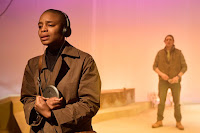
It centres on Allen (playwright Lorenzo Allchurch), a hapless young guy living in his family's sprawling home after the death of his mother. He hangs out in her sculpting shed, where his closest companion is a huge bust of William Burroughs (voiced by Jason Isaacs), which pokes and prods Allen with sneery wordplay. He's visited by his competitive brother Jack, their absent father and the ghost of their mother (all played by Gabriella Moran). And a local cop (Leah Aspden) comes to investigate strange noises and other things going on here.

Allen can't afford to keep this house, and the bank is about to foreclose. But he is frozen in inaction, unable to decide what to do or how to move on. And he has never dealt with issues that have haunted him since his childhood. Burroughs' sardonic suggestions aren't helping, and neither are the other people around him, real or imaginary. So it's clear that fate needs to step in, and indeed it does.

On a very effective minimalist black stage that features inventive props, lights and projections, Allchurch gives a full-on performance, spiralling through this situation as a young man who isn't really searching for answers, but he needs them. It's a fascinating performance, even if the play itself becomes a bit frustrating as it spins in nutty circles with its impenetrable dialog and some surprising swerves in the plot. Thankfully, the psychological intensity of it all holds the interest.

The key idea here is that we all need to find a way to let go of things that prevent us from moving forward with our lives, including objects, places and even the memories that keep us stuck in place. And of course mental health issues are also part of the conversation. All of this comes through with a provocative kick in the dense dialog and plotting, which flips into an unexpected final scene that offers a glimmer of hope. 

For details,
PARK THEATRE > 
photos by Mark Senior • 1.Aug.25

Thursday, 24 April 2025

Stage: Dancing with death

How to Fight Loneliness
by Neil LaBute
director Lisa Swirling
with Justina Kehinde, Archie Backhouse, Morgan Watkins
set and costumes Mona Camille • lighting Chuma Emembolu
Park Theatre, London • 16.Apr-24.May.25
★★

Neil LaBute takes on another thorny topic with this 2017 play, which is making its UK premiere at the Park Theatre. Because the issue is so intense, there is a level of engagement here that feels undeniable, even as the play itself seems to drift within its own monologues, never quite cracking the surface. It perhaps doesn't help that it takes more than half an hour for the subject matter to emerge, deep into a scene that is essentially an extended red herring. This somewhat undermines the characters themselves, leaving them oddly unlikeable even as we want to identify with them.

In a living room that is designed to look like a desert, with a dirt floor, stone furnishings, dried-out foliage and a sun-like lamp suspended in front of a sky-like backlit wall, a loved-up young white-collar couple is laying out snacks and drinks for a guest. Brad (Archie Backhouse) invited this stranger over against his better judgement, while Jodie (Justina Kehinde) feels like she needs him. Eventually, the working-class Tate (Morgan Watkins) arrives, and it turns out that he went to school with Jodie. It also emerges that, due to rumours about his past, Brad and Jodie think he would be perfect to help Jodie end her suffering as she comes to the end of the road regarding treatment for a fatal brain tumour.

A fundamental flaw in the premise never stops niggling: Jodie says she has tried suicide multiple times but simply can't do it, but she is also unwilling to relocate to a state like Oregon, where euthanasia is legal. By contrast, Brad wants her to fight for her life, even though it's clear that she has been doing so for many years, including a period of remission. His yearning is about what he is losing, both Jodie and the children he hoped to have with her. Both of them state and restate these feelings over the course of the play's two-plus hours. Opposite them, Tate's quirky and eerily dispassionate responses feel like the voice of reason and compassion. But they contain their own flaws, because he is compromised by his own feelings.

This situation develops through circuitous conversations, as each of person opens up about their internal feelings while never quite moving forward. Kehinde is the soul of the play, adding resonant emotions at every point, largely because this is Jodie's story and hers are the only feelings that matter. Her physicality also conveys a wonderful sense of dignity and resolve that drives the narrative forward. Watkins' brings intrigue to the enigmatic Tate, overcoming the caricature of the stereotype with engaging internalised nuances. Comparatively, Brad is written as much more one-note, which doesn't give Backhouse much to work with, so he has to strain to earn the audience's sympathy.

While the sets and costumes add interest and texture, as does a lively injection of humour into the dialog, much of this is essentially random (such as Tate's amusing insistence that he's not a vegetarian even though he doesn't eat meat). And there's a certain nervous energy that flows throughout each scene, as these people try to explore bigger ideas in their twisting, spinning conversations. So there are fascinating questions along the way about perspective and empathy, expectations and extrapolations. But there are also no real insights, aside from a point that there is ultimately no trick to getting through this messy thing called life.


For details, PARK THEATRE >
photos by Mark Douet • 22.Apr.25

Friday, 4 April 2025

Stage: Lockdown diaries

Jab
by James McDermott
dir Scott Le Crass
with Kacey Ainsworth, Liam Tobin
lighting Jodie Underwood • music & sound Adam Langston
Park Theatre, London • 2-26.Apr.25
★★★

Inspired by true events, James McDermott's drama feels like a period piece, set very specifically during the pandemic. And while it nostalgically journeys through the key events and issues of those years, the focus is on a marriage that was already in trouble before lockdown pushed it over the edge. The two actors are excellent, playing the short, sharp scenes with punchy interplay that is often wordless. But the story never feels layered enough to resonate meaningfully.

It opens as NHS worker Anne (Kacey Ainsworth) starts working from home during the covid outbreak. Her well-paying job has supported raising two sons with her husband of 29 years, Don (Liam Tobin), who runs a vintage shop that doesn't bring in much. And now that it is forced to close, his only earnings are from government grants. Anne never lets Don forget that she's the breadwinner and he's a slacker. And he never shows any respect for her at all, beliveing it's her role to cook, clean and take care of his sexual needs. So it's not surprising that being stuck at home together brings larger tensions to the boil.

Much of this is very ugly, even if there are glimpses of affection and camaraderie between Anne and Don, plus some warm nostalgia when they're drinking. But there is also verbal and physical abuse. So neither is very likeable, striking low blows that cut deep as they increasingly separate from each other across the four armchairs lined up on the stark living room set. As the title suggests, vaccines play into the story, as Don refuses to get the jab, even as Anne is working in vaccination and testing centres. He resents her insisting that he should be vaccinated, when his beloved Daily Mail shouts nonstop about fake side-effects. And she tells him she'll resent him when he dies.

No prizes for guessing where this goes. Director Scott Le Crass stages this cleanly in the small studio space, as events unfold in sometimes very tiny fragments over many months. Both Ainsworth and Tobin are gifted actors who are able to provide some subtext to their roles. This makes the characters intriguing, even if they're only rarely engaging. But the main problem is that this is a pointed play about the strain covid put on relationships, and it never finds much to say to us five years after the fact.

For info, PARK THEATRE >

photos by Steve Gregson • 3.Apr.25

Wednesday, 5 February 2025

Stage: Who do you trust for the truth?

Antigone [on strike]
writer-director Alexander Raptotasios
with Phil Cheadle, Hiba Medina, Ali Hadji-Heshmati, Sorcha Brooks, Hanna Khogali
dramaturg Or Benezra-Segal
set Marco Turcich • lighting Ariane Nixon
costumes Marie-Cecile Inglesi   
Park90, Park Theatre, London • 30.Jan-22.Feb.25
★★★★

Reimagined from real events, this intense drama is inventively staged to draw on the way a news story plays out through political grandstanding and attention-grabbing headlines. It's also an astute spin on Sophocles' classic tragedy about a woman seeking justice in a system tilted against her. And there's an extra kick in the way writer-director Alexander Raptotasios so cleverly weaves interactivity into the narrative, forcing the audience to make key decisions that provoke responses and reveal deeper ideas.

The set is a whitewashed replica of the House of Commons, as MP Creighton (Phil Cheadle) rails against the young Esmeh (Hanna Khogali in video calls), who has been stripped of her British citizenship after leaving the UK as a 14-year-old to marry an Isis fighter in the Middle East. Now her husband is dead, as is one of her two children, leaving her a refugee without a home. In London, her sister Antiya (Hiba Medina) is at her wit's end after a court case goes against Esmeh, so she goes on hunger strike outside the Home Office. Her boyfriend Eammon (Ali Hadji-Heshmati) supports her, but has a serious conflict of his own.

All of this plays out in a swirl of verbal and visual activity, with headlines and messages projected onto the various surfaces of the set, including pointed questions posed by a TV news show host (Sorcha Brooks) that the audience answers on a keypad, then the results are projected as well. The story moves briskly over 90 minutes, as the adept cast members create various other characters who fill in the story, adding points of view that are both annoyingly loud and beautifully nuanced.

Performances are excellent across the board, as the cast commits to some properly earth-shattering moments. Dialog overlaps and scenes shift very quickly. Cheadle never flinches at Creighton's hardline right-wing views, strident and harsh in his refusal to see the human side of this situation, even as it affects his own family. Both Medina and Hadji-Heshmati have far more sympathetic roles, creating both warmly involving and darkly wrenching moments as Antiya and Eammon navigate a perilous situation. These young people simply want to see justice prevail amid terrifyingly over-amped events.

Packed with terrific details and stagecraft that skilfully deploys sights and sounds, this ambitious play is dazzling, never getting lost in its topicality because it continually reminds us that this is a story about flawed people who are simply trying to do the right thing as they see it. By involving the audience in the decision-making, the experience creates unusually personal angles that counter-balance the more academic discussions and lofty prose. So this becomes about much more than Islamophobia, child trafficking, media manipulation or military intervention. The salient questions become "Do you feel well informed enough about this situation?" and "Who do you trust for the truth?" And then even more chillingly, "Should the majority rule?"


For details
, PARK THEATRE > 
photos by Nir Segal • 3.Feb.25


Thursday, 30 January 2025

Stage: Down the rabbit hole

The Gift
by Dave Florez
director Adam Meggido
with Nicholas Burns, Laura Haddock, Alex Price
design Sarah Perks • lighting David Howe
music & sound Abby Galvin
Park Theatre, Finsbury Park • 22.Jan-1.Mar.25
★★★

Springing from a high-concept premise then spinning wildly out of control, this snappy black comedy is written in such an entertaining way that we barely realise that it's playing with big issues rather than actually grappling with them. Dave Florez has a wonderful way with dialog, injecting witty banter that livens up a series of raucously uncomfortable moments. The steady stream of jokey puns and acerbic observations often feels overwritten, but it's also very funny, as it's essentially a portrait of three people who use wit to obscure what they really think.

It opens on a spotlit cake box on a kitchen counter, which Colin (Nicholas Burns) received that morning. Now he's joined by his sister Lisa (Laura Haddock) and brother-in-law Brian (Alex Price), peering at the human excrement inside and wondering who could have possibly sent it. Lisa knows that Colin is unlikely to take this with a grain of salt, and sure enough he begins obsessing about both who and why. Laura and Brian make a joke of it, and try everything they can to calm him down, but their own relational issues come into play as the situation grows into an existential crisis for all three of them.

Set completely in Colin's living room over several months, the play's dialog brims with pointed zingers as these people find amusing ways to refer to this head-scratching predicament as it escalates exponentially. The actors' dive in fully, making each of these characters big personalities who are equally likeable and infuriating. At the centre, Burns gives Colin a nicely quirky observational sensibility that leads him down all kinds of rabbit holes, overwhelmed by the task of apologising to every person he may have wronged. There are elements of panic and confusion that are easy to identify with, and these of course set off alarm bells for Haddock's pragmatic Lisa and Price's jocular Brian, who is perhaps too quick with a wisecrack for everything.

Indeed, there's a relentless intensity to this play, with such a continuous flow of spiky humour that the characters and situations begin to feel artificial. It's thoroughly enjoyable to watch, simply because the spiralling conversations are so jam-packed with fizzy wordplay, although this means that we are hearing people tell hilarious stories rather than watching events unfold on-stage. And many of the deeper issues, such as the machismo swirling between Colin and Brian, are brushed off as silly rather than properly explored. 

Much more interesting are the little rifts that reveal themselves between the characters, within marriage, friendships and between siblings. And Colin's inability to just get on with his life is also fascinating. These are by far the most involving things about this play, even as it remains focussed on its central gag and final punchline. 

For info, PARK THEATRE >

photos by Rich Southgate • 18.Jan.25 


Monday, 19 December 2022

Stage: Turn of the century

I time-travelled back to the beginning of the 20th century twice over the weekend - first for the atmospheric thriller Wickies at the Park Theatre and then for the lavish on-stage extravaganza Circus 1903 at the Apollo Hammersmith. Very different experiences, set only a couple of years apart...

Wickies: The Vanishing Men of Eilean Mor
by Paul Morrissey
dir Shilpa T-Hyland
with Graeme Dalling, Jamie Quinn, Ewan Stewart
music Niall Bailey
set/costumes Zoe Hurwitz
lighting Bethany Gupwell
illusions John Bulleid
Park Theatre, Finsbury Park, London • 30.Nov-31.Dec.22

Based on a true mystery that has never been solved, this wonderfully creepy dramatic thriller is set at the isolated Flannan Isles lighthouse far off the coast of Scotland in 1900. The script is a wonderful mix of island lore and interpersonal clashes, as three very different men have their own reactions to being cut off from the world in a foggy limbo that's haunted by myths and a possible curse. It's beautifully directed and designed to evoke a feeling of separation from the rest of society, and to embrace the things that can never quite be understood.

A weteran wickie, aka lighthouse keeper, James (Stewart) was involved in building this particular lighthouse on Eilean Mor a year earlier. Far from his family, has now chosen to be stationed here alongside hot-tempered Donald (Dalling), who ignores the no-alcohol rule. They are joined by rookie Thomas (Quinn), whose wide-eyed curiosity raises memories of past events the other men are trying to forget. From the fuzzy ancient history of the island's abandoned chapel to a series of unexplained deaths in recent years, these men have no idea that they're headed toward their own inexplicable fate. 

Along the way, the actors occasionally shift roles to play investigators looking in to the disappearance of these three men during a season in which the fog was so thick that the lighthouse couldn't be seen by passing ships. These kinds of details combine wonderfully with the tactile staging, visceral underscore and superbly subtle special effects work. So there are continual moments of emotional intensity and chilling nastiness.

All of which elevates the even more intriguing ideas about belief, notably expressed in the contrasting layers of masculinity between these men, which is impeccably underplayed by the actors. And since it's so involving, we don't worry about the fact that nobody knows what happened to these men. The various possible explanations are far less engaging than letting our minds embrace something that can't be answered. So the show feels like the bracing slap of an ice-cold wave.
For information, visit PARK THEATRE > 
photos by Pamela Raith • 17.Dec.22

Circus 1903
dir Neil Dorward
creative producer Simon Painter
with David Williamson, Sabrina Aganier, Noel Aguilar, Keniel Rodríguez Mesa, Mikiale Gebrekidan, Temesegene Geberetnsaa, Senayet Asefa Amare, Tymofii Chemko, David Schnabel, Yani Stoyanov, Valeri Tsvetkov
set Todd Edward Invins
costumes Angela Aaron
lighting Paul Smith
Hammersmith Apollo, London • 25.Dec.22-1.Jan.23

Mimicking the look and feel of a vintage travelling circus, while peppering the show with modern-day wit, this production centres mainly around astonishing physicality. This makes it feel more grounded than flashier circus shows, especially with so many genuinely jaw-dropping displays of sheer skill. In between these, there's plenty of goofy humour and audience participation, which strains the attention spans of the kids in the audience. And the involvement of two full-size puppet elephants adds a hint of spectacle.

The show is hosted by Ringmaster Willy Whipsnade (Williamson), a slightly smarmy prankster who spins stories and pokes fun at himself while introducing the acts. Occasionally getting children from the audience involved, he also fills the role of the clown who annoyingly pads out time between the performances. Thankfully, each act is properly impressive. The show opens with a lively teeterboard routine featuring four beefy high-flying men who look like they're having a lot of fun.

Highlights along the way include snappy juggler Aguilar, who throws a ridiculous number of spinning objects into the air and catches most of them adeptly. He's so engaging and ambitious that no one minds when something falls. Stunning balancing act Rodriguez (and his assistant Roxy) piles so many rolling elements on top of each other that it's a bit worrying. And aerial artist Aganier bends herself impossibly as she dangles from a ring far above the stage.

The company encircles each of the acts, cheering on their fellow artists to offer a terrific sense of community. And there's some surprising pathos in the appearance of the elephants, a towering mother and her cheeky son, brought to uncanny life by a crew of puppeteers. Oddly, the show never builds to a crescendo, remaining grounded and earthy right to the final performance of two acrobats (Gebrekidan and Geberetnsaa) who offer an amazing display of power and balance. It's goosebump-inducing, but not quite the grand finale we expect.

Along the way, the international makeup of the cast offers additional textures, with performers coming from across North and South America, Africa and Europe. All of them are the very best at what they do, and it's wonderful to see them live on-stage as part of such a superbly varied ensemble. And with its mix of sophistication and silliness, it will keep the entire family entertained.

For information, visit CIRCUS 1903 >
17.Dec.22